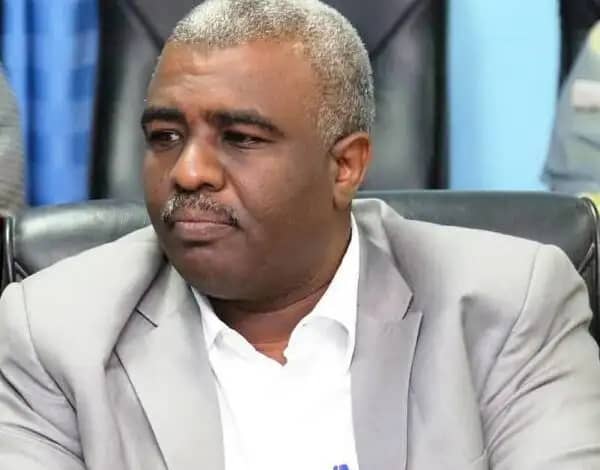
The visit of Lieutenant General Mohamed Ibrahim Mufaddal last week to Washington and New York was a pivotal one, at which the scene of the war and the course of the state may be rearranged in a shift drawn by the Sudanese Intelligence Service. Sudan, exhausted by an internal war driven by greed for its resources, suddenly returns to the heart of American calculations as a security and intelligence node in one of the world’s most turbulent regions: the Red Sea and the Horn of Africa. In this space, it is well known that politics is not run by statements, but by secret maps, interest-based approaches, and shadow files.
The information that leaked about the nature of the talks indicates that the meetings were not confined to the U.S. State Department, but included the Central Intelligence Agency and the Department of Defense, and focused on three major headings: counterterrorism, securing the Red Sea, and drying up the financing and arming networks of the Rapid Support Forces militia, with a clear American position rejecting any scenario of dividing Sudan or legitimizing a parallel government. This alone is enough to reveal that Washington no longer views Sudan as a marginal civil war, but rather as an arena of important international balances, where ambitious Russian aspirations, promising Chinese expansion, and expanding Iranian calculations intersect.
Most likely, according to sources, the Saudi–American initiative file was present at the core of these talks,
alongside the Sudanese initiative for peace and the restoration of security presented by Prime Minister Dr. Kamel Idris before the Security Council. The linking of the two tracks came as an attempt to reposition Sudan as the party that sets the terms for ending the war and moving to the next day. The continuation of the reference of the Jeddah Agreement of May 11, 2023 gives Khartoum negotiating backing and forces any international effort to align with national priorities rather than leap over them.
But what truly changed is Washington’s perception of the “Rapid Support.” It is no longer seen as an armed force out of control, but as a cross-border network of violence that practices mass killing and ethnic cleansing and runs a war economy based on weapons, smuggling, and gold. In this context, the idea of a “balanced peace” between two warring sides becomes a moral and political illusion.
A peace that equates the executioner with the victim is not peace, but a postponement of a more brutal round of war. Hence a new logic seems to be advancing: before any settlement, there must be a legal and moral reckoning that redefines who the legitimate party is and who is the party outside international and humanitarian law, which, in light of the violations it commits against civilians according to the United Nations, amount to war crimes.
Sudan’s repositioning within the equation of U.S. national security practically means its transformation from a conflict arena into a partner in containing a regional threat. Arms smuggling, funding routes, and the movement of drones have become political pressure tools in Khartoum’s hands. If invested wisely, these cards block any attempt to recycle the Rapid Support Forces militia as a political partner and open the door to a peace built on the restoration of security and the state.
At the heart of this transformation stands the Sudanese Intelligence Service. The history of the intelligence relationship with Washington says that this channel, even in the harshest periods of isolation when it was previously run by Salah Gosh according to shared interests, remained a thin thread that never broke, especially in the files of terrorism, irregular migration, and organized crime. Today, with a war tearing apart geography and sovereignty, this role returns more centrally: not only to protect American interests, but to protect the very idea of the Sudanese state from disintegration.
The coincidence of Mufaddal’s visit with the tour of the U.S. Deputy Secretary of State in East Africa confirms that Washington is reshaping its approach to the Sudanese file: from managing a crisis to trying to control its outcomes. Therefore, talk of technical arrangements agreed upon to monitor any potential ceasefire should not be read as a Sudanese concession, but as closing a loophole that the militia has long exploited to redeploy and rearm under the cover of a ceasefire.
At the same time, the international legal track is moving according to what appears to be agreed arrangements. The International Criminal Court is raising the ceiling of the characterization of crimes in Darfur and El Fasher to war crimes and crimes against humanity, and in some cases approaching the designation of genocide. This convergence between intelligence and law creates a new environment: the regional patrons and funders of the militia find themselves faced with two choices only—either withdraw, or face a heavy political and legal cost.
In return, according to sources, President al-Burhan requested time to study the Saudi–American initiative by presenting it to the Security and Defense Council, an expression of a precise awareness of the gravity of the stage alongside the preparations underway to establish peace. Therefore, it is expected that a ceasefire will be preceded by the dismantling of the Rapid Support Forces system so that the disasters of previous settlements, in which violence is rewarded with political representation, are not reproduced.
Thus, what is happening in Washington is not a search for a truce, but for an effective formula based on approaches that re-engineer the coming phase on different terms whose features have begun to appear in regional and international movements.
Accordingly, we can say that the war has begun to move from the fields of bullets to the arenas of files, evidence, and international courts. Here, at this cold, harsh, and realistic level, the balance of power is being redrawn. Because Darfur is no longer merely a stricken region, but has become a moral and political compass: either its victims are granted justice, or its blood remains fuel for postponed wars.
Satellite images, the testimonies of survivors heard by the United Nations High Commissioner for Human Rights Volker Türk recently during his visit to the country, mass graves, and supply maps all intersect today in closed rooms in Washington and The Hague to produce one narrative: a militia that cannot be politically whitewashed. And with every file opened, the space in which this force can operate outside the logic of accountability narrows.
In this sense, Mufaddal’s visit, the activation of the International Criminal Court, and the Saudi–American initiative are all read in one context as a fabric being slowly woven to condemn the militia and produce a peace with no war after it.
Thus, and according to #TheFaceOfTruth, in the effectiveness of intelligence diplomacy, the halls of The Hague, and the calculations of Washington and Riyadh, the contours of a new scene are formed: a peace that does not ask the victims to forget, does not grant the killers a certificate of absolution, but tries, for the first time since the outbreak of the war, to link the end of fighting to the beginning of justice. In this linkage alone can Sudan find its path toward stability and the beginning of a state that regains its balance in a world that shows no mercy to the weak.
Wishing you well and in good health
Thursday, January 22, 2026 Shglawi55@gmail.com