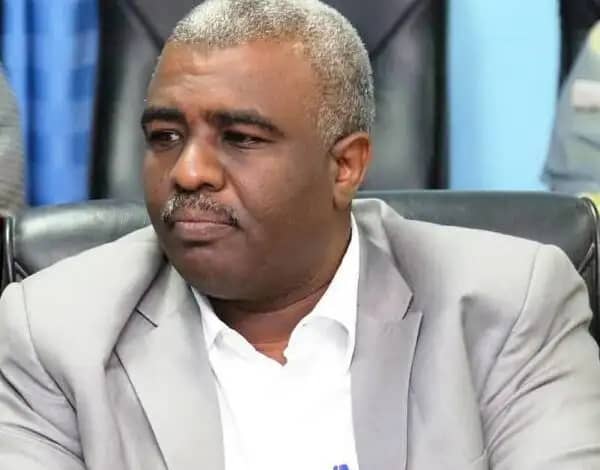
General Abdel Fattah Al-Burhan, Chairman of the Sovereignty Council and Commander of the Army, called yesterday for a return to the Independence Flag. This call comes at a critical moment that reflects the intersection of political, security, and social crises in our country.
This step is an indicator of a broader direction to recalibrate the national scene and to summon the foundational moment of the state as a solid reference for rebuilding a new Sudan, especially amid the fragility of political parties and the persistence of divisive and hostile rhetoric that weakened the ability of civilian forces to manage the transitional period following the fall of Al-Bashir’s regime in 2019.
The Independence Flag, with its three colors—blue, yellow, and green—raised in 1956, becomes, according to Al-Burhan’s statement, an instrument for reuniting national identity and demonstrating the army’s ability to fill the political vacuum and reorganize the state. Many observers see the timing as appropriate and strategic, given its connection to preceding events and the conditions of the transition: the memorial of the Sudan Liberation Army Movement martyrs, the ongoing battle against the Rapid Support Forces—“The Battle of Dignity”—and the Sudanese people’s sense that they are fighting alone. This existential confrontation, described by Volker Türk, the UN High Commissioner for Human Rights, as “a proxy war waged to seize Sudan’s natural resources.”
In this important context, Al-Burhan’s message unfolds in several directions. Domestically, it reinforces state unity and reaffirms the army’s role as an institution capable of leading the transitional period and safeguarding national sovereignty.
Externally, it signals to regional and international powers that the army is the sole guarantor of Sudan’s unity and independence, and that any threat to national institutions will be met decisively.
This call carries a clear vision of the kind of state the army seeks to establish: a strong central state, with cohesive institutions capable of enforcing security and restoring balance in the relationship between authority and citizens—away from partisan quotas and historical divisions. In this context, the army is the guarantor of security and stability, and a central actor in rebuilding the state from the ground up, transforming the historic symbolism of the flag into a practical project for rebuilding governance institutions. Hence the importance of recognizing this historical moment and immediately completing the transitional structures by forming the legislative council, as it is one of the tools that protects this foundation.
Al-Burhan’s call also includes a recalibration of the meaning of national legitimacy. While some may view the move as nostalgia for the past, it is in fact an attempt to reproduce the unified national state that brings people together beyond partisan divisions, internal conflicts, and regional and international pressure.
The message has become clear: the coming phase will not be built on fragile settlements or the division of spoils at the expense of Sudanese citizens, but on a deeply rooted national project capable of enforcing security, restructuring the state, and shaping its national identity.
Thus, returning to the Independence Flag serves as a revival of the first foundational platform—one that can become the basis for rewriting the constitution, institutions, and administrative structures in a way that restores Sudan to its natural position as a unified sovereign state.
At the regional level, this move is read as a strong signal to countries monitoring Sudan’s developments: the army is prepared to restore the state to its natural center and its old national identity, regulate internal affairs, and protect sovereignty against external interventions.
Some states supportive of Sudan’s stability will view it as confirmation of the army’s ability to lead the transitional period, while other powers will approach it with caution, seeing it as part of the ongoing struggle over legitimacy and the reconfiguration of internal and external influence.
Meanwhile, the international community will observe the step as an indicator of the current leadership’s direction toward unifying the state narrative and restoring its foundational symbols, though it will remain cautious until tangible signs of transition and institutional rebuilding emerge.
The success of President Al-Burhan’s call, then, is not tied to the flag itself, but to the ability of this symbolism to evolve into an integrated national project that returns Sudan to its founding platform and reshapes the rules of political engagement internally and externally.
Yet the power of the flag as a symbol of unity is certainly not absolute. Sudan’s experience—like that of other nations—shows that a flag acquires political and moral meaning only when it is connected to reality: the state’s ability to protect its citizens, the credibility of its institutions, and the presence of a shared national narrative that transcends ethnic and regional divisions. The Independence Flag is a summons of the collective memory and the early moments of foundation when Sudanese people united to expel the colonizer and take charge of their nation, far from opportunists and defeatists.
According to Face of Truth, Al-Burhan’s announcement of returning to the Independence Flag is part of a strategic project to deeply understand the Sudanese crisis, leveraging historical symbolism as a tool for unifying the state, rebuilding its institutions, and protecting its sovereignty and resources against internal challenges and external ambitions. This obliges the army to lead a new phase with a clear vision of Sudan’s path toward an independent and unified state. A flag alone cannot create unity, but it becomes a potent tool when connected to just political and social action.
Wishing you well and in good health.
Tuesday, 2 December 2025
Shglawi55@gmail.com