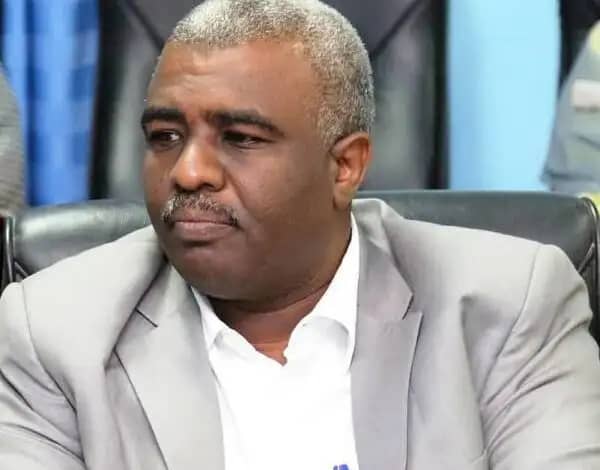
“My dismissal has nothing to do with my performance.” With this brief statement, Dr. Lamia Abdel Ghaffar Khalaf Allah opened her remarks following the decision to relieve her of her position as Minister of Cabinet Affairs. A short phrase, yet one that opens a wide door of questions about what is happening within the structure of power in Sudan, and about the nature of state management during this transitional phase that requires a high degree of political organization and evaluation of executive performance to restore confidence in state institutions after the war.
The former minister’s statement came after she received the dismissal decision on Thursday evening, confirming that the step was taken based on the Prime Minister’s request for organizational reasons that do not affect the quality of the work she provided during her period of assignment. She also expressed her pride in being the first Sudanese woman to assume this ministerial position, a post that requires coordinating the government’s executive work and managing its agenda during one of the most complex periods the Sudanese state has experienced since the outbreak of the war in April 2023.
According to what she explained, her acceptance of the assignment came in response to the call of duty at a moment when state institutions were facing a difficult test. In the midst of war and the disruption of large parts of the executive apparatus, the work within the Council of Ministers seemed closer to restarting a state machine that had suffered major disruptions under the pressure of conflict.
During that period, the ministry focused on reorganizing work, restoring information systems, and preserving the state archives, in addition to maintaining the regular meetings of the Council of Ministers and approving Decision No. (170), which she described as having established a roadmap for the tasks of the executive apparatus.
The ministry also worked on reviewing civil service records and preparing proposals to reintegrate employees affected by the war, in addition to launching strategic projects for the years 2026–2027 to develop the civil service and apply the concepts of comprehensive quality management. It also sought to establish a decision-support center concerned with analyzing information, formulating policies, and addressing economic and social challenges.
However, the story of the dismissal appears, in the view of many observers, surrounded by a degree of political ambiguity that goes beyond the explanation presented to the public.
While the official clarification stated that the decision was due to organizational reasons, some readings of the political scene point to the existence of a latent disagreement within the circles of power, particularly regarding the overlap of competencies between the Reconstruction Committee chaired by Lieutenant General Ibrahim Jaber and the Council of Ministers. The work of this committee overlapped with the powers of the Council of Ministers, which made the Prime Minister distant from files that fall within his jurisdiction.
In this context, a letter issued earlier by the Council of Ministers emerged, stipulating that ministers were prohibited from participating in committee meetings without the knowledge of the council. The step was understood as an attempt to regulate the boundaries between Jaber’s committee and the Council of Ministers.
From this perspective, the dismissal decision can be interpreted as part of a process to rearrange decision-making and influence within the state.
Yet reading this incident cannot be complete if it is limited to this decision alone. Since the change in 2019, the scene has continued to move within a connected circle of appointments and dismissals in senior positions. These changes were not limited to ministries; they extended to states, boards of directors of companies, and banks, until the replacement of leadership positions became a recurring feature within the machinery of government work.
From a personal angle, I can perceive some features of this scene through a direct experience. A conversation took place between me and the former minister some time ago in which she expressed her desire to appoint me as a media advisor to the ministry after my return from Umrah.
Despite my lack of interest in such positions due to a previous experience with public service, I expressed a preliminary willingness to accept, not out of desire for the position as much as appreciation for her personally and for what I knew of her as a serious administrative vision seeking to make a difference in the governmental experience. Her experience had been shaped through years of work in a number of national and international institutions, which granted her accumulated expertise and an ability to manage complex files.
In any case, selecting another person to succeed her in managing this sensitive position remains a difficult task, especially since many had viewed her as a potential candidate for the position of Prime Minister. However, the matter of selection in Sudan is no longer linked to competence alone, as political and regional considerations have entered the equation of distributing positions. With the signing of the Juba Peace Agreement, these equations emerged more clearly, bringing the old recurring question to the surface: Is the state managed according to the logic of competence or according to the logic of political balances?
Then the war in April 2023 added a new layer of complexity to this scene. State institutions were subjected to a violent shock during which work was disrupted, the government was absent, and leadership positions changed within a short period of time, which weakened the stability any state needs to conduct its affairs effectively.
Within this reality, a new government was formed under the name “Government of Hope,” expressing a desire to open a horizon for stability after the disruption. Yet the continuation of the approach of appointment and dismissal raises an important question again: How can state institutions plan and operate amid this degree of rapid change in leadership positions?
Governments in times of crisis may resort to reshaping their executive circles in search of harmony in decision-making. However, such steps, no matter how justified they may be, remain incomplete in their impact if they are not accompanied by a sufficient degree of transparency that explains to public opinion their reasons and backgrounds. Politics, in its essence, is the art of managing trust.
International experiences offer a clear lesson in this regard: advancement begins with proper selection first, then granting the necessary mandate to work without direct interference in details.
Strategic planning, according to Face of the Truth, requires stability. Stability requires trust. And trust does not grow in a turbulent administrative environment. When decisions become part of a clear and declared vision, and when the relationship between the state and society is built on transparency and accountability, only then can it be said that Sudan has truly begun to move toward a state of institutions rather than a state of desires.
Wishing you well and good health.
Sunday, March 15, 2026
Shglawi55@gmail.com